CHAPTER 06 / 06
Roasting Case Study: Venezuela (Washed / Medium-Dark City Roast)
On this page
This document is an empirical log recording the roasting of a Venezuelan fully washed green coffee to a medium-dark (City) roast, executed in accordance with the Standard Process Guide.
- Roast Date: August 18, 2026
Batch Specifications (Step 0)
| Parameter | Set / Measured Value | Notes |
|---|---|---|
| Coffee Origin / Lot | Venezuela Mucucay (2024/2025) | - |
| Variety | Castillo, Monte Claro, Caturra | - |
| Processing Method | Fully Washed | - |
| Input Green Bean Weight | 144.0g | Standard unit (1kg bag divided into 7 batches) |
| Washing Water Temp | 50°C (Purified water) | Chaff and floater culling |
| Soaking Solution | 50°C water + 15g honey + 20g fructose | 30-minute soak |
| Post-Soak Bean Weight | 190.3g | Measured after removing 12.0g of defective floaters |
| Initial Bean Temp | 28.7°C | Infrared reading immediately before roasting |
| Initial Bed Volume | 300–325ml | Visual cylinder reading |
| Total Weight (incl. container) | 459.4g | - |
Profile Projection
Consistent with typical washed coffees, the hydrated weight reached 190.3g (near the upper baseline limit). Because the objective is a medium-dark roast (City Roast), the profile was designed to supply sustained thermal energy through the mid-to-late stages.
Detailed Roasting Operations
Steps 1–2: Setup
Secure the lid on the container and place the cylinder vertically on the wooden chopsticks centered on the microwave floor.
Step 3: Initial Uniform Preheating (300W)
| No. | Power | Exposure | Agitation Interval | Volume Trend | Operational Notes |
|---|---|---|---|---|---|
| 1 | 300W | 60s | 23s | 325ml | Preheating initiated |
| 2 | 300W | 60s | 25s | 325ml | Steady temperature rise |
| 3 | 300W | 60s | 25s | 325–350ml | Initial expansion from internal steam pressure |
| 4 | 300W | 60s | 52s | - | Interval extended for intermediate weighing |
- Step 3 Cumulative Heat Input: 72k Ws (300W × 60s × 4 sets)
- Step 4 Pre-check Metrics: Outer wall temp 90.2°C / Total weight 456.7g (Moisture loss: 2.7g)
- Assessment: An outer wall temperature around 90°C and 2.7g moisture loss align cleanly with standard baseline criteria, indicating low thermal runaway risk. A standard 26- to 27-step profile was deployed.
Step 4: Primary Heating (High + 500W Medium Power)
Applied the "800W + 500W × 50s" alternating cycle designed for higher-moisture batches. The lid was burped (<1s) during each agitation interval.
| No. | Power | Exposure | Agitation Interval | Volume Trend | Operational Notes |
|---|---|---|---|---|---|
| 5 | 800W | 30s | 35s | 325ml+ | Rapid temperature rise |
| 6 | 500W | 50s | 30s | 325ml | 50-second pulse accumulates thermal mass |
| 7 | 800W | 30s | 29s | 325ml | Thermal boost |
| 8 | 500W | 50s | 32s | 300–325ml | Volumetric contraction commences with moisture loss |
- Step 4 Interval Heat: 98k Ws / Cumulative Total: 170k Ws
Step 5: Steady-State Heating (Crack Preparation via Medium Power)
Employed 500W × 50s in the first half to build energy, shifting to 600W × 40s in the second half to enhance thermal uniformity.
| No. | Power | Exposure | Agitation Interval | Volume Trend | Operational Notes |
|---|---|---|---|---|---|
| 9 | 500W | 50s | 30s | 300–325ml | Continued moisture evaporation |
| 10 | 500W | 50s | 26s | 300ml | Surface yellowing starts |
| 11 | 500W | 50s | 31s | 300ml- | Shifting from yellow to light brown |
| 12 | 600W | 40s | 22s | 275ml+ | Switched to 600W |
| 13 | 600W | 40s | 28s | 275ml | Maximum volumetric contraction phase |
| 14 | 600W | 40s | 28s | 275ml | Uniform brown color spreading |
- Step 5 Interval Heat: 147k Ws / Cumulative Total: 317k Ws
Step 6: Thermal Boost Driving into First Crack
Based on bed color and volume dynamics, another round of energy was deemed necessary to cleanly initiate the crack. Instead of the 30-second pulses used for lighter roasts, two sets of 600W × 40s were applied.
| No. | Power | Exposure | Agitation Interval | Volume Trend | Operational Notes |
|---|---|---|---|---|---|
| 15 | 600W | 40s | 30s | 275ml | Driving temperature upward |
| 16 | 600W | 40s | 26s | 275ml+ | First crack commences (volumetric turning point) |
- Step 6 Interval Heat: 48k Ws / Cumulative Total: 365k Ws
Step 7: Driving First Crack (800W / 600W Alternating Boost)
To maintain crack momentum and thoroughly transfer heat through to the bean cores, alternating sets of 800W × 20s and 600W × 20s were conducted.
| No. | Power | Exposure | Agitation Interval | Volume Trend | Operational Notes |
|---|---|---|---|---|---|
| 17 | 800W | 20s | 29s | 275–300ml | Early first crack (isolated pops) |
| 18 | 600W | 20s | 30s | 275–300ml | Latent heat transfer |
| 19 | 800W | 20s | 27s | 275–300ml | First crack continuing |
| 20 | 600W | 20s | 30s | 300ml- | Expansion progressing |
| 21 | 800W | 20s | 30s | 300–325ml | First crack peak |
| 22 | 600W | 20s | 32s | 300–325ml | First crack subsiding |
- Step 7 Interval Heat: 84k Ws / Cumulative Total: 449k Ws
Step 8: Finishing & Second Crack Development
Targeting a medium-dark roast (City to Full City boundary), the roast was taken cleanly into second crack.
| No. | Power | Exposure | Agitation Interval | Volume Trend | Operational Notes |
|---|---|---|---|---|---|
| 23 | 600W | 15s | 21s | 300–325ml | First crack completely ended |
| 24 | 600W | 15s | 25s | 300–325ml | Quiet period immediately prior to second crack |
| 25 | 600W | 15s | 25s | 300ml- | Second crack commences (fine, sharp snaps) |
| 26 | 600W | 15s | 0s | - | Second crack peak confirmed; terminated immediately |
- Step 8 Interval Heat: 36k Ws / Cumulative Total: 485k Ws
Step 9: Discharge and Rapid Cooling
Discharged immediately onto the cooling tray; recorded bean temperature and applied forced air cooling.
- Discharge Bean Temperature: 226.9°C
- Total Post-Roast Weight: 110.0g (Net yield after 0.8g defect culling: 109.2g)
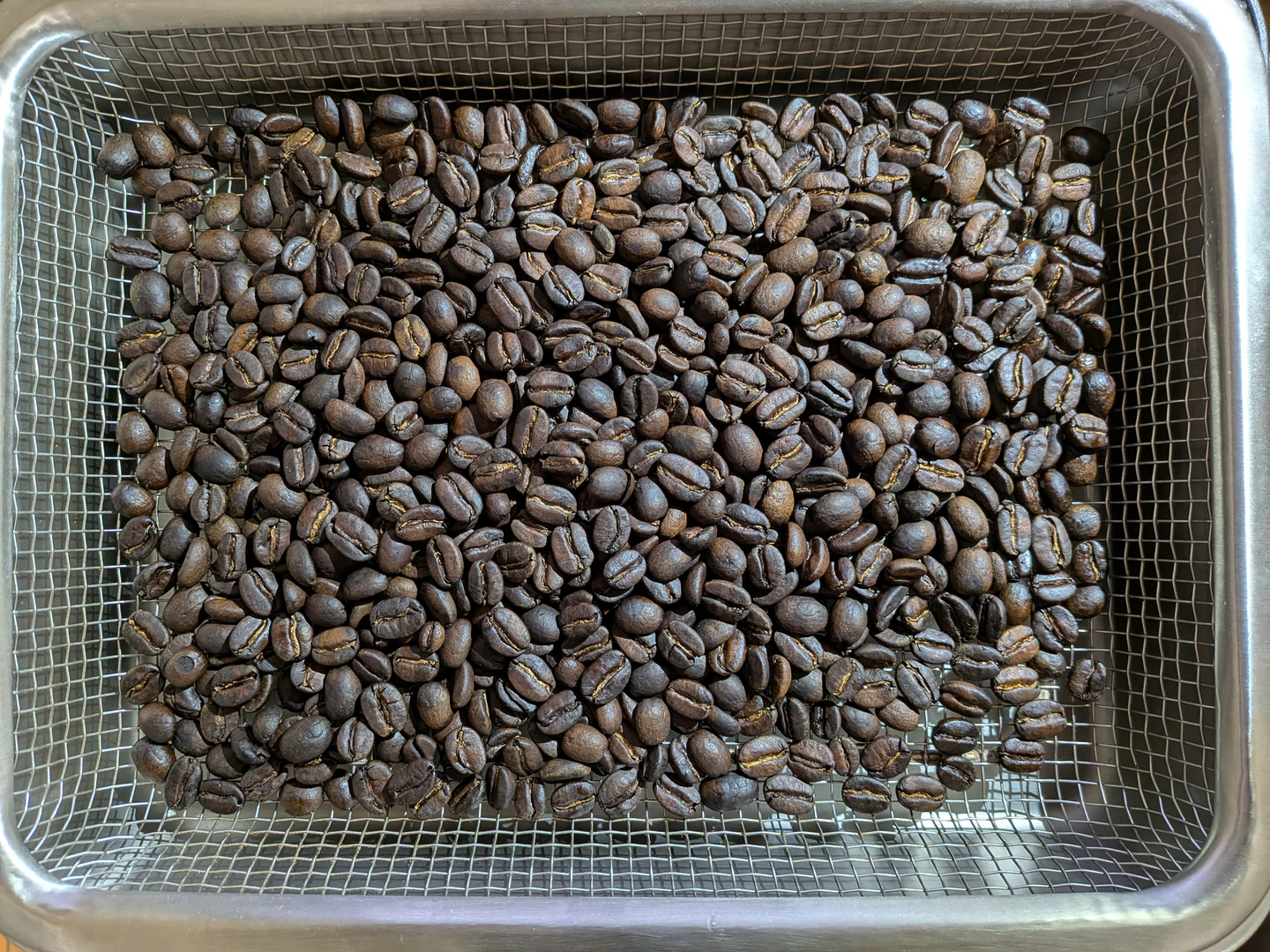
Roast Summary
| Evaluation Metric | Measured Value |
|---|---|
| Total Steps | 26 steps |
| Net Microwave Exposure Time | 15 min 30 sec |
| Total Elapsed Time (incl. agitation) | 27 min 31 sec |
| Discharge Bean Temperature | 226.9°C |
| Finished Bean Weight | 110.0g (76.4% of dry green weight) |
| Total Cumulative Energy | 485k Ws |
| Time-Normalized Equivalent Energy | 1057.54 kW/h |
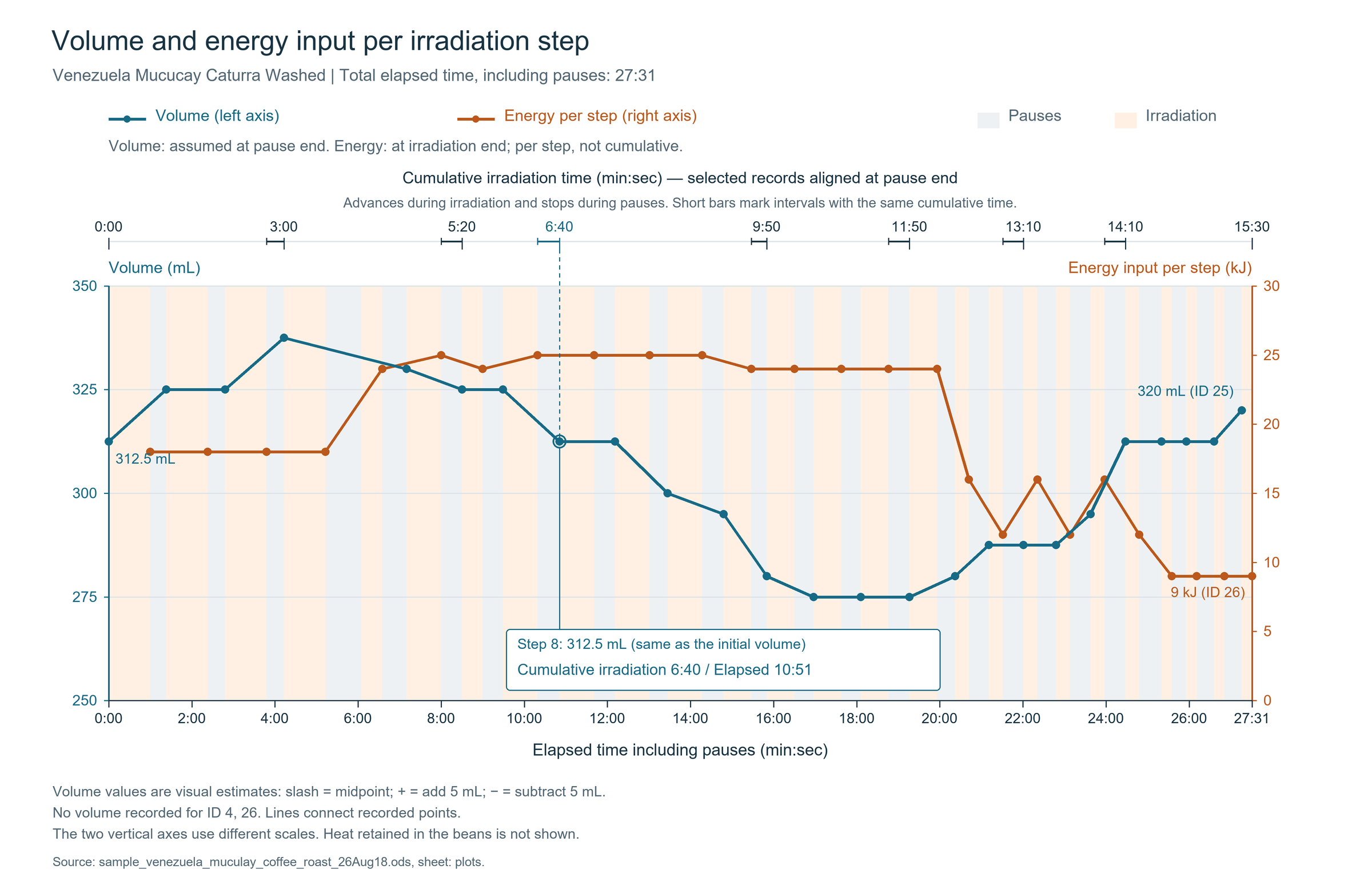
Technical Analysis
Completing in 26 steps with 485k Ws cumulative energy and a final discharge temperature of 226.9°C successfully captured the entry into second crack, delivering the intended medium-dark City roast profile with clean body and rich caramelization.
Even with a washed lot requiring substantial latent heat of vaporization, the time-normalized energy metric was 1057.54 kW/h, remarkably close to the empirical standard baseline (approx. 1,060 kW/h). The high reproducibility of this index underscores the reliability of thermal mass management in microwave coffee roasting.